It’s taken us about eight years, but we have now finally completed David Eldridge’s trilogy of plays exploring love and relationships. Like its predecessors Beginning and Middle, End is a two-hander which plays out as a real-time conversation. The focus of Beginning was on two young lovers on the night they met at a house party, while in Middle we met two people in an established relationship which had begun to go south. The narrative of End – as you may already have guessed – looks at two people who are aware their time together is nearly over.
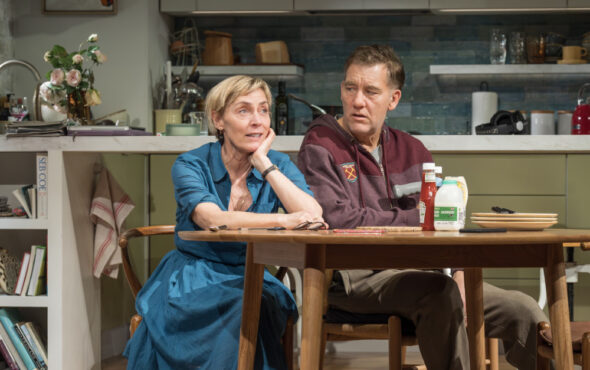
The couple in question are Alfie (Clive Owen) and Julie (Saskia Reeves), both in their 50s and successful in creative careers – Alfie as a DJ, Julie as a novelist. They met in their early twenties and have been together most of their adult lives; however, they have recently discovered that Alfie’s cancer diagnosis is terminal, and they are grappling with the idea of what happens next after nearly a lifetime together. The pair are not in agreement: Alfie is keen not to prolong the inevitable, and go out with dignity on his own terms, while Julie wants to pursue any possible treatment for the sake of a little more time together.
As with the two previous plays, End is set in early 2016, during the dying days of the old world order. It does feel slightly surreal watching a relatively contemporary setting – they’re using mobile phones, they’re buying sourdough from Gail’s bakery – and yet they’re also living in a world which doesn’t know Brexit or President Trump. It’s a world that in reality isn’t so long ago, and yet feels ever so distant.
It probably goes without saying, but End is not an easy watch – the story is really rather sad, the script is a bit heavy going in places. And yet it makes for compelling viewing: the couple are convincing, and there’s a pleasing mix of the profound and the mundane. Life’s tragedies are dissected with warmth and humour over a pot of tea that is never drunk. It all flies by rather briskly (90 minutes, no interval) in a house that feels lived-in. There are perhaps one or two too many speeches – the play works a lot better in the quiet, human moments than when it’s overtly trying to make a point – but these don’t disrupt the flow too much.
While it may not tackle the easiest material, we had an enjoyable evening with End. If you’ve already seen its predecessors it probably goes without saying that you should probably catch the finale – we’re pleased to report that it’s a satisfying conclusion. Even if you haven’t seen the others, it works perfectly well as a standalone piece of theatre, thanks to some interesting ideas being discussed and two tremendous acting performances.
GAY TIMES gives End – 4/5
More information can be found here.
Latest