Why can’t I stop thinking about her? Welcome to the sapphic world of limerence
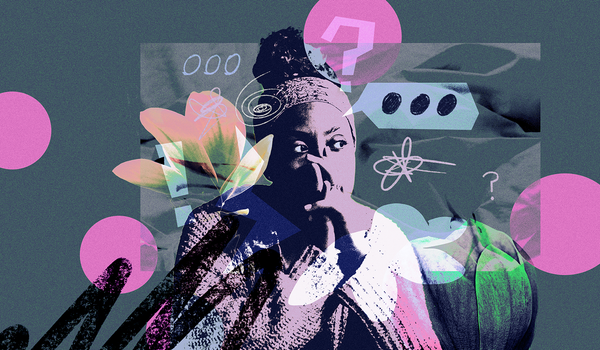
Checking her stories. Re-reading her texts. Losing your mind over three little dots. When does a crush become limerence – and why does obsessive yearning seem to hit sapphics particularly hard? Katie Baskerville unpacks.
When new love blooms, and the promise of twitterpation hangs thickly in the hedonistically charged air – you know the drill.
Checking your phone every two seconds, reading (and then re-reading) every word, scouring for meaningful subtext that could tell you more about what your new love's intentions are for your weary, tender heart. We've all questioned that full stop, asking: Are they mad? Should I text again? Do they like me like me? Or are we just fuckbuddies?
We've all hung on to every word, interaction and expression, clammy-palmed and eager for more. Did they watch my story? Did they like my post? Will they be present and accounted for at the next meet-up? What does it all mean?
We can't help it. We're crushing hard. Bubbling over with new relationship energy. Because, as it happens, we're falling head over heels in love. Well, as it turns out, maybe not love, actually.
Listen, at the beginning of any new relationship, we often don't know if we're coming or going. It's normal to be practically fizzing and giddy while we try to find our feet and figure out, 'What are we?'
Our emotional energy has the capacity to swing pendulum-like from an anxiety-prone, crumbling mess to totally fine when we see those magical three ellipses animate.
Dot dot dot – kyrie eleison, indeed.
Untethered by tech and cast adrift in performative dating cycles
Tech has a lot to answer for. The world thrust teeny-tiny computers into our hands that sapped our attention, placed barriers to intimacy and then sold us solutions that are gamified and dopamine-driven.
And yes, we know that the internet and being connected to every single person on the fucking planet has led to a lot of good (ahem). But when we're talking about limerence and love, the dating game cycle and problematic smartphone use have turned a little vibration into a reward system. Gluttons for punishment, we can't stop ourselves from repeating the check–nothing–check—nothing—buzz—OMG MESSAGE, delicious dopamine cycle.
"It just doubles down on the cultural kind of limitations of access," says expert Nikki Scott, sex and relationship therapist, educator and founder of The Sex Ed Club in Brighton.
Scott explains that for queer people, seeing each other on social media or on apps may, on one hand, make us feel seen and validated in our identities, but on the other, only shows us the best or most attention-grabbing bits.
"So, [social media] amplifies limerence. This idea that you are objectifying, or looking at this person through rose-tinted glasses, and they're not available to you in your area keeps you in an untethered state."
Limerence is an obsessive kind of infatuation, and while it certainly doesn't exist solely on our phones, they certainly aren't helping matters.
"[Social media] amplifies limerence. This idea that you are objectifying, or looking at this person through rose-tinted glasses, and they're not available to you in your area keeps you in an untethered state."
Scott continues to explain that, in her opinion, dating apps weren't made with queer people in mind. "I don't think dating apps were designed for the way that queer people love and interact. It's really performative, very reductive."
So, how can you tell if it's love – or limerence? And, if you can tell, what can you do about it?
Beyond the U-Haul stereotype, why is sapphic culture claiming limerence?
We all know the joke that the 'urge to merge' is strong within the sapphic community, given that we show up to our second dates with a U-Haul in tow.
From hot-takes to hard-hitting journalism, our long-reads put you at the centre of queer life and culture. The best LGBTQ writing, insight and opinion, curated for you.
Support our work by subscribing today and enjoy must-read stories by the voices you love.