
Freaky queer clowns are everywhere. Here's why
Clowncore has taken over queer nightlife, But beneath the painted faces and big looks, there’s something more subversive at play, so what makes being ridiculous such a radical act?
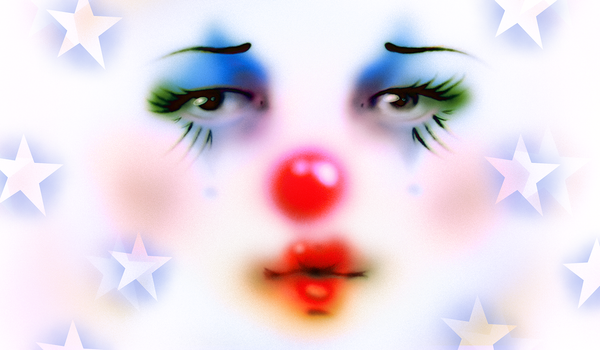
I’m walking through a park in Bristol with a velvet red ball squished around my nose, teardrops kohl-pencilled under my eyes and a pointy hat with matching neck ruffles my friend knitted for me in pink, purple and blue. The bisexual flag colours, naturally. I’m at my friend’s clown-themed birthday party, and it’s surprisingly difficult to find because it’s not the only clown party happening in the park. When I do arrive, there’s one person not dressed up, who quickly explains that they’re experiencing “clown burnout” from “too many queer clown nights in the city”.
At first, this might sound like something you could only overhear in Bristol (the Portland of England to give our American readers some context). But they have a point. While most of us save the clown costumes for Halloween, queer people have been embracing clownery for a while. This year, though, the trend has gone decidedly loud, proud and gloriously chaotic.
From London’s queer art-rave Riposte, which hosted an all-clown techno rave at Electrowerkz, to Bristol’s Big Tops & Bottoms’ ‘Bring Back the Clowns’ night, LGBTQ+ club nights are embracing the aesthetic in a big way. Private queer parties resemble circus tents, while it seems like every queer person’s For You Page is packed with clowncore, from self-deprecating queer clown memes to makeup tutorials and general clown pride.
So, why do we love clowns so much?
“Queer people also often have a solid amount of trauma. And being a clown character can be a coping mechanism for that."
For 28-year-old Ella, an artist from Bristol, it’s a personal appeal. When I ask about their love of clowns, they happen to be in the middle of making clay clown decor to sell on Etsy.
“Queer people also often have a solid amount of trauma,” they explain. “And being a clown character can be a coping mechanism for that. I'm allowing you to laugh at me as a clown instead of laughing at me for who I am as a person.” By choosing to become the spectacle, the clown gets to reclaim the joke and invite others in.
Michelle Tea, author of Clowns: An Anthology, has a few ideas about why clowning and queerness go hand in hand. She points to “the sense of a sort of failure on parade” and “buoyant pride in that failure”.
In a world that still treats heterosexuality and conventional gender expression as the default, the clown captures the pain of being cast as a failure for not conforming.
The clown is an outsider who makes a spectacle of not fitting in and owns the room with it. Tea describes the clown figure as someone who “tried to be a person and failed, gaining all the wisdom one gains from such situations.” This idea has deep roots in queer culture, tracing back to Pierrot, the original “sad clown”: a gender-fluid figure of social alienation later channelled by the likes of Lindsay Kemp and David Bowie. In a world that still treats heterosexuality and conventional gender expression as the default, the clown captures the pain of being cast as a failure for not conforming. But by turning that alienation into theatrical spectacle, queer clownery transforms supposed failure into a source of pride, resistance and art.
For 38-year-old Sam, from the West Midlands, their love of clowns is closely tied to gender expression as a non-binary person. “I think clown is kind of like a third space like my gender is in a way. Both are outside of normal. I do think that a clown transcends gender.” Plus, they add, “Clowns are hot!”