Rani KoHEnur is “nama-slaying” her way to international notoriety
The drag superstar talks Queen of the Universe and why we “need and deserve a Drag Race India”.
The drag superstar talks Queen of the Universe and why we “need and deserve a Drag Race India”.
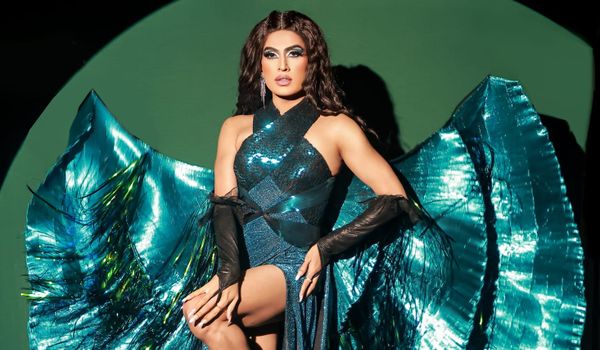
“I have to be present,” proclaims Rani KoHEnur. “I have to, because how many people [in India] changed their perspective by looking at me on national television? I became the person I wanted, urged and craved. I had to. I didn’t have a choice.” One of the most prominent LGBTQ+ people in her home country, Rani memorably made history as the first drag artist in India to participate on a reality singing show with her appearance on its longest-running game show, Sa Re Ga Ma Pa.
Last year, she continued to “nama-slay” on an international scale when she was announced as a contestant on Queen of the Universe, World of Wonder’s singing competition that collects some of the world’s fiercest drag vocalists to compete for $250,000. Hosted by Graham Norton with pop diva judges Michelle Visage, Trixie Mattel, Leona Lewis and Vanessa Williams, Rani – who already boasted over a million followers on Instagram – became an immediate fan-favourite thanks to her powerhouse pipes, infectious breakup duet with winner Grag Queen and deadpan sense-of-humour.
Although she didn’t conquer either competition, Rani says the real “reward” for her isn’t the cash prize: it’s the overwhelmingly positive reactions from fans she meets “on a daily basis”. “People have come up to me and actually said, ‘We were homophobic and transphobic before we saw your performance,’” Rani tells GAY TIMES. “Imagine someone who could have chosen to attack you standing there and saying, ‘Thank you for changing my perspective.’ If I can be the medium for that change, then I’ll be it. […] That is my compensation. That is giving me all I need to wake up the next day and slay harder.”
With three films on the horizon, as well as a “party” anthem with Grag Queen and a brand new YouTube series which sees the star interview the “real sheroes of the trans community,” we caught up with Rani to discuss her drag origins, how the art-form “empowered” her to live authentically as a trans person and why the world ‘needs’ Drag Race India. “I’m going to host it,” Rani says defiantly, “and I will definitely open and close [each episode] with a performance because I can.”
First of all, thank you! Your publication is, by default, one of my favourites because you tell such wonderful stories. I was most excited about the fact that I could unleash Rani and the KoHEnur experience on the world, and better late than never that we had an Indian queen from India on any sort of drag show internationally. We don’t have this in India, and as unfortunate as it is, we don’t have many spaces for drag artists. It was also very surreal for me to look at Trixie Mattel, Michelle Visage and Vanessa Williams, especially, and be in the same room as them, as well as queens from all around the world. I was very happy to see the representation and the diversity on that stage. And let’s not forget your local legend Sir Graham Norton! I watched The Graham Norton Show on YouTube because we don’t get it on television here, just like we don’t get a lot of things. It’s very limited queer content in India, so I think for me, to become that representation for the next generation, it just adds fuel to the hustle.
You won’t believe it. I was in America just a couple weeks back and I toured different cities. The South Asian community… They are so with it. They watch, eat and breathe drag. Also, the cis-het people that came to watch the show, I was shocked! They don’t see it as a gay or trans or queer show, they see it as a variety show where it’s just art and performance. There are no labels. Unfortunately, I don’t think we’re there in the Indian industry, which is why I’m more than just a “drag performer”. I’m a performer first and everything later. I want the heteronormative majority to understand that this is an art-form. When I went to America and saw people enjoying themselves when I sang Bollywood, in Europe as well I might add, there’s a lot of South Asians and Brown communities and they love the fact that we are authentic. This is a Sarai, and I love wearing the Indian Sarai and garments and amalgamate that with Western influence. It’s not just this or that, it’s both. It’s a party. It’s a production! When I saw them loving it, I came back much stronger to my country and said, ‘Now, I have to hustle even harder. I want my country to be like this, where there’s no stereotypes or discrimination against trans people, queer people, drag queens.’ I’m getting there, hopefully, fingers crossed.
£12.99 Monthly
£57.99 Annually
Cancel anytime
No results found. Try a different search.