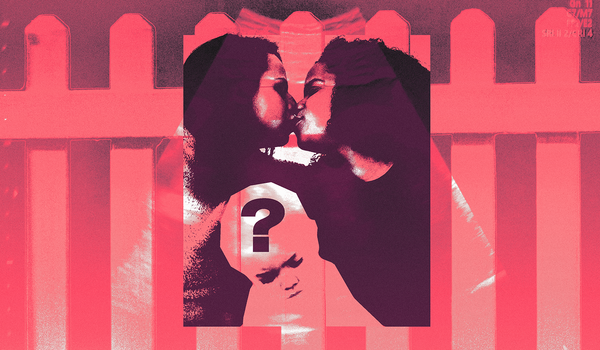
For lesbian couples, the possibility that you both could carry a child can make the decision not to feel like a burden. But there’s only so long you can stay “on the fence” about motherhood. Emily Chudry shares her and her wife’s journey to being happily childfree and explores the cost of trying.
A few winters ago, my wife and I spent a rainy afternoon playing The Sims. Choosing both of our worst features, we joked about whether our potential child would inherit my pre-braces teeth or her terrible eyesight, my unruly eyebrows or her skinny ankles. Creating this strange Franken-Sim in peals of laughter, it hit me. Though neither of us were desperate for children, I’d never considered the reality of what was possible for us. In the back of my mind there was a strange sadness that we could never have the opportunity to share our DNA in a child. There would never be a toddler with her full, dark waves of hair and my freckles.
I’d always been conflicted about children, never feeling a strong desire for motherhood and harboring an active terror of childbirth. Somewhere deep down though, before I realised I was queer, I thought maybe the decision would eventually be taken out of my hands; I’d end up with a man, get pregnant, and that would be it. Now, as a cis woman married to another cis woman, there’s no way for us to have a child without actively trying hard to have one. This sudden realisation that I couldn’t stay ‘on-the-fence’, I couldn’t nudge it down the road or accidentally fall pregnant one day, felt almost like a loss.
Having children altogether can be a fraught decision, from fertility struggles to extortionate childcare costs. For queer people, however, there can be an extra layer of complexity. In the UK, it wasn’t even possible for queer couples to raise children until relatively recently; same-sex adoption was legalised in 2005, while equal rights for lesbians to undergo IVF or insemination were implemented in 2008. In the US, it’s a similar story, with nationwide same-sex adoption only fully legalised in 2017.
In the UK, it wasn’t even possible for queer couples to raise children until relatively recently; same-sex adoption was legalised in 2005, while equal rights for lesbians to undergo IVF or insemination were implemented in 2008.
“It’s really hard to imagine yourself as a parent as a queer person,” Lisa Boccuzzi from New York tells Gay Times. “I think that’s part of the reason why so many queer people are on-the-fence, because you’re like, ‘wait a second, what does this look like?’ I haven’t seen it.”
Boccuzzi had been undecided about children for a long time before she and her wife had a baby; her reasons were myriad, from struggling with health anxiety and OCD, to not wanting to be pregnant, to not wanting to conform to society’s ideals of what a woman should be.
“When society says, ‘in order to be a good woman in society, you have to have a kid, and you have to buy a house, and you have to move to the suburbs’, I’ve always been very much someone who likes to go against the grain in that regard,” she explains. “I said to myself, ‘I can’t see myself in that at all, that doesn’t really resonate’, but what I found is that motherhood isn’t one-size-fits-all, and being a parent doesn’t have to look like that.”
After getting married in 2022, the couple went through the process of IVF, which sparked a realisation for Boccuzzi that much of the information surrounding conception and parenthood is geared towards cisheterosexual couples.
“When you look into fertility treatment, so much of the data is around straight couples who’ve struggled with fertility,” she continues. She says the only timelines she saw laid out “years and years” of fertility treatments, however because her and her wife hadn’t struggled with infertility, it only took around a year from the initial consultation to her daughter being born, a shorter timeline than she had expected to wrap her head around the idea of parenthood.
“We got really lucky every step of the way, everything worked on the first try”, she says. “It’s just really interesting to be a queer person navigating this because it’s so different from what you would typically see other couples using fertility treatment for.”
Another complication for Boccuzzi was the cost of IVF, with “roadblocks” in place when it came to insurance. As the fertility benefits her wife accessed through work only technically covered IVF if the couple had proven infertility, the couple had to pay back the money they had received in order to conceive their daughter.
NHS-funded fertility treatments for queer couples are still described as a “postcode lottery”, and some have claimed they were ineligible for NHS treatment. For trans people, the decision can be more complex.
It was this experience that led Boccuzzi to believe there should be more information and support for queer people exploring parenthood. She explains that the “beautiful thing about social media” is that other LGBTQIA+ people can help illuminate the process, with the Reddit page Queerception proving useful on her journey. In turn, she’s aware she’s now representing queer parenting to others who may look to her for inspiration and information.
“To be that example and be that representation, especially for other queer younger people, it brings so much joy,” she says.
‘Parenthood can be a life-altering decision’
The process of IVF and conceiving, I admit, hadn’t crossed my mind when thinking about children, but my concerns did extend to the complexities of raising a child within a queer family. Both myself and my wife have been subjected to street harassment and homophobia, and we, like 48% of LGBTQIA+ parents, fear a child could be bullied because they have a queer family. With LGBTQIA+ rights being dragged frighteningly backwards, many queer people worry homophobia and transphobia could impact a future family.
Melody Li, licensed marriage and family therapist and founder ofInclusive Therapists, says “social and structural discrimination” can “pose disproportionate challenges towards queer couples when making decisions around becoming parents”.
From hot-takes to hard-hitting journalism, our long-reads put you at the centre of queer life and culture. The best LGBTQ writing, insight and opinion, curated for you.
Support our work by subscribing today and enjoy must-read stories by the voices you love.