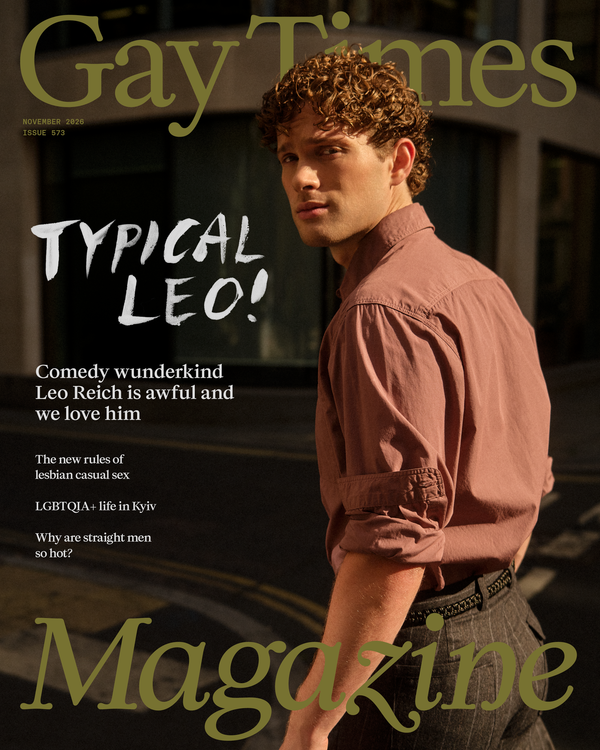
Leo Reich: 'There's a romantic and erotic quality that's part of the gay community's fabric – a shared desire'
The comedian, actor and writer on getting Andrew Scott to spit in his mouth, why gay people should be allowed to be awful, the absolute horror of dating apps and his new comedy It Gets Worse.
Interview by Lotte Jeffs Photographer Rhys Framtpon Styling Steven Huang Grooming Charlie Cullen Cover Design by Yosef Phelan
GAY TIMES: We need to talk about that Andrew Scott scene, obviously. We know our core audience. Tell us everything.
LEO REICH: I feel so bad that that's the first thing that went viral for the show. He’s in one scene.
GT: It's a fantastic scene.
LEO: He is amazing. I love him so much. I sent him the scene in this sort of delusional way.
GT: Did you know him? Did you have an in?
LEO: I knew him a tiny bit because we did Too Much together. And I said what was true, which was that when I was writing the scene, I thought he'd be perfect for it. Which, considering the scene, is a really weird thing to say to someone you don't know that well.
GT: It's quite flirty…
"I thought, ‘I'm going to prison. [Andrew Scott is] filing a restraining order against me. This is the weirdest way I could possibly have framed this.’ Like, ‘Made me think of you!’ What?!"
LEO: It wasn't meant to be! And then I look back on it… He was doing Vanya in New York at the time. So he wasn't really on his phone, and it took maybe a week to get a response. During that week I thought, ‘I'm going to prison. He's filing a restraining order against me. This is the weirdest way I could possibly have framed this.’ Like, ‘Made me think of you!’ What?!
GT: Did you write in the spitting bit, or was that an ad-lib?
LEO:Imagine if that was an ad-lib.
GT: So tell us about filming it. Were you nervous?
LEO: I’m nervous before every scene, but he's so amazing and so up for having a laugh with it. We improvised a bunch of other stuff around the scene, although not that bit. Every take was a little bit different. Saying he's a pro makes him seem uptight in some way, and it was the opposite. It felt so free and relaxing. As soon as we'd done one take I was like, ‘Well, this is going to be a great day.’ He's so generous. And I feel like this about all the people who guest-starred – Lena Dunham, Zadie Smith, Amelia Dimoldenberg, Blake Harrison. It's a Channel 4 show, no one's making money. The reason all these people decided to do it is because they thought it'd be fun.
GT: Well, also maybe because it's good?
LEO: And hopefully because it's good.
GT: Does that feel validating? When I say, ‘Maybe it's good,’ can you actually accept that?
LEO: No. Next question.
GT: Really?
LEO: No, it does. It felt really validating. It was really cool that people I love and admire said yes. They were all the people I went to for those parts because they were my dream choices. It wasn't me going, ‘What famous person could I email to do this part I've written?’ It was, ‘I've written this for this person with them in my head. I may as well chuck them an email. What's the worst that can happen? I look like a freak.’ And they all said yes. I still can't believe it.
GT: I love that you just casually emailed Zadie Smith.
LEO: That was the weirdest one because I do not know this woman. I'd had one conversation with her at the Too Much premiere. I sent this long email about her work and why it felt really right for her to do it, blah, blah, blah. And she sent an email back being like, ‘Sounds great. When shall we do it?’
GT: How long did you spend writing the show?
LEO: After the pilot got commissioned, I wrote it in just under a year. Which was intense.
GT: And you didn't originally intend to star in it?
"I think by the end [Ethan is] redeemable, but at the beginning it's like, ‘Fucking hell, man. Shut up.’"
LEO: No. That decision came relatively late in the day, which I think was a good thing because I'd already written drafts of most of it. I think I would've gotten in my own head earlier if I'd been explicitly writing for myself.
GT: Do you think you wouldn't have written the sex scenes if you'd known you'd be on screen?
LEO: Weirdly, not that bit. I felt fine about that. It was more the fear of people thinking the character is me, because he's obviously totally unbearable.
GT: I quite liked him. At various points.
LEO: I think by the end he's redeemable, but at the beginning it's like, ‘Fucking hell, man. Shut up.’
GT: That's what's interesting about gay people on screen, though. The extent to which we're allowed to be awful. There's so much pressure around positive representation.
LEO: Part of the reason it's called It Gets Worse is that it's a spin on "It Gets Better". There's sometimes a forcedness to the cuddly, optimistic, representation-based queer narratives. Those stories are good, and they need to be there, and they're inspiring for people. But you get to a point where you're like, ‘Well, a lot of the gay people I know are really difficult to be around. Where are they on TV?’
* * *
GT: OK, I want to go back to the beginning. What were you like as a child?
LEO: I grew up in Holloway, Tufnell Park. My primary school was at the end of my road, which was quite sweet. I was really obsessed with animals. I probably owned ten different salamanders, a gecko, two different kinds of toads, at least ten praying mantises, a Madagascan hissing cockroach…
GT: Wow.
LEO: This could be the whole interview where I just reel off so many bugs. I would go to the bug fair, which is where different breeders and traders of live insects would go.
GT: What appealed to you about insects?
LEO: There's something, on a base level, fun about it. And if I'm going to be pretentious, a sense of awe and mystery. Tiny beautiful things.
GT: Did your siblings have to put up with your little menagerie?
LEO: Everyone has to put up with me in general. My sister still feels traumatised by being dragged around so many nature reserves. But I had the same thing with my older brother, where I was dragged to football games. I wouldn't touch that.
GT: Tell us about being a little gay kid. How did that manifest?
LEO: It didn't until I went to secondary school. Everyone's dressed in little suits. I'm 11, why am I dressed in a suit? And then it became progressively more complicated. It was quite bad at points.
GT: Bullying?
"I don't think I was ever bullied, but at an all-boys school, being really homophobic all the time was just a big part of the landscape."
LEO: Not so much bullying. Internally, emotionally bad. I don't think I was ever bullied, but at an all-boys school, being really homophobic all the time was just a big part of the landscape. It wasn't necessarily in a serious, felt way, but when you're struggling with your sexuality in that context, even the light-hearted, quote-unquote "light-hearted" banter feels really personal.
GT: So were you battling with shame? Or is that overstating it?
LEO: It's certainly not overstating it. Massive shame. Massive anger.
GT: Anger towards yourself?
LEO: Totally. Furious at myself. I was also so competitive as a child that it felt like a failure for a long time. Like a big imperfection. It felt very unfair. Which is a funny feeling to have, like, ‘This is so unfair.’
GT: From what you’ve told me it sounds like you came from a progressive, liberal family where it was safe to be gay at home?
LEO: Totally. But they're still English. So it's a repressed progressivism. There's a vibe that everything's fine, but not necessarily a conversation. It's up to me to have the conversation. I came out to my parents when I was 19.
GT: How did you do it?
LEO: Through stand-up at the Edinburgh Fringe Festival. My therapist has a field day with this story. Absolutely loves bringing it up in every context. I was doing a sketch show at Edinburgh, but also a bit of stand-up, and I invited my parents to come and watch. It was a student mixed-bill comedy night. I was on second, doing ten minutes, and I did really quite explicit material. There was a joke which I still think, ‘You know what? That's not bad for 19.’ I'd been going out with this guy who I'd lost my virginity to, and he'd ghosted me. And the joke was, ‘It feels so ironic to me that I ended up losing my gay sex virginity to a cunt.’ That was my opener.
GT: Incredible.
LEO: So I did my ten minutes, left, and my parents had to sit through another 50 minutes of appalling pseudo-comedy. Then I texted them saying, ‘I don't want you to say anything. I'll meet you here at this time to see another show together. I don't want you to say anything other than it was really funny.’
GT: And did they?
LEO: They said it was really funny.
"I'd been going out with this guy who I'd lost my virginity to, and he'd ghosted me. And the joke was, ‘It feels so ironic to me that I ended up losing my gay sex virginity to a cunt.’"
GT: And then you just never spoke about it again?
LEO: No. That was it. It wasn't like anyone was upset. I just didn't want to have an earnest sit-down conversation.
GT: What don't you like about earnest sit-down conversations?
LEO: My god. How long have we got? At the time it was just cringe. Also, when you can't really cope with something yourself, to then have to be in a position of holding someone else's hand through it felt like too much for me. I knew that whatever they said back was going to piss me off in some way. Every single response would be wrong. So I was like, ‘How about just no response? I'm in complete control. Also, we're having a laugh.’ There's a way of looking at it as a really lovely thing, and a way of looking at it as, ‘Oh god, what a terrifying level of avoidance.’
GT: Maybe it's both.
LEO: Maybe it's both.
***
GT: Let's talk about dating. What's happening? What's your situation?
LEO: Oh, let's lock in. I need a more specific question.
GT: What's it like to be 29 and dating in London?
LEO: 28!
GT: Sorry, 28. What is good about it, and what is horrible?
LEO: What is good about it? Ha. Really racking my brains for a positive here.
GT: I think that's saying quite a lot. Do you want me to throw you some options?
LEO: Yes, please.
GT: Is it a nice way to explore different sides of yourself with different people?
LEO: I guess so. I'm going to make some of the most over-worn points of all time.
GT: Go for it.
LEO: In terms of being gay, there's a sexual, romantic, erotic quality that's part of the fabric of the community. A shared desire. And it's a really nice way of melting some of the boundaries or restrictions around what kind of relationship you can have with someone. It makes you realise that people can be anything to you. I have lots of friends where the relationship started romantic or sexual, and now we're friends. That's happened the other way around in my life as well. You go through periods where things change, and that's lovely and freeing.
GT: Friends become lovers, lovers become friends?
LEO: There's less rigidity around the expectations of your relationship with someone and what it can be. Those things can blur and be malleable. You can figure it out with that specific individual person. It doesn't have to run along certain conventions.
"In terms of being gay, there's a sexual, romantic, erotic quality that's part of the fabric of the community. A shared desire."
The flip side is the more isolated, atomised app-dating thing, which does the opposite. Every interaction you have with anyone in that context has to follow certain conventions because it's locked within an app that hands you those conventions. So it's actually extremely restricting. I don't really engage with it anymore because I found it a hideous nightmare to enter a situation where you're first meeting someone and, essentially, if you don't have sex, you've failed.
GT: Really?
LEO: You've seen each other's pictures. You know that you would, in theory, have sex with them. And if you don't, it's because your personality is so bad. Do you know what I mean? I'm being brutal about the sex element, but I mean that if there's not a romantic connection, you're not going to be anything else to each other. The date goes well and it's romantic, or you're strangers again forever.
GT: Or you're friends.
LEO: Sometimes, yes. But because that person wasn't in any way part of your life previously, it's not like you've run into them in a bar. For them to be a total stranger and then be able to recede back into being a total stranger, I think it makes you interact with people really differently. There's no sense of being held to account for your behaviour by a community of people you're around. I think that's changed the standards for how people interact. You wouldn't ghost someone if they were your friend's friend.
GT: Did dating get harder as you became more recognisable? Did the door to Raya suddenly open?
From hot-takes to hard-hitting journalism, our long-reads put you at the centre of queer life and culture. The best LGBTQ writing, insight and opinion, curated for you.
Support our work by subscribing today and enjoy must-read stories by the voices you love.