
“Pop culture is queer culture”: World of Wonder’s Fenton Bailey on new book ScreenAge
World of Wonder co-founder Fenton Bailey speaks with GAY TIMES about his new memoir, ScreenAge: How TV shaped our reality, from Tammy Faye to RuPaul’s Drag Race.
World of Wonder co-founder Fenton Bailey speaks with GAY TIMES about his new memoir, ScreenAge: How TV shaped our reality, from Tammy Faye to RuPaul’s Drag Race.
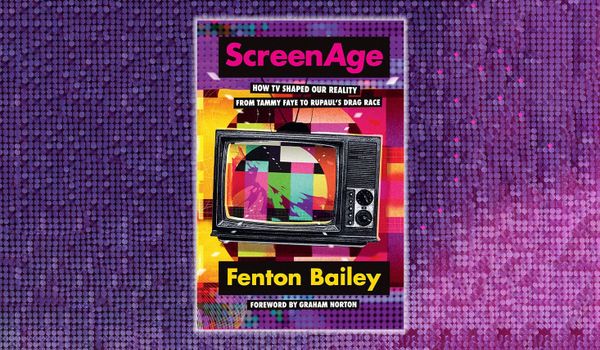
“Drag has become mainstream. Being gay became cool,” Fenton Bailey writes in ScreenAge. “From being the criminal outsider, being queer has even become representative of the way the outsider voice is common to us all.” Subtitled ‘How TV shaped our reality, from Tammy Faye to RuPaul’s Drag Race’, the filmmaker’s memoir offers an in-depth analysis of how – in his words – “popular culture is queer culture” while chronicling how he and his partner, Randy Barbato, changed the course of reality television and queer representation on the small screen with World of Wonder.
Founded in 1991, the production company has earned universal acclaim thanks to productions such as The Eyes of Tammy Faye (2000), Mapplethorpe: Look at the Pictures (2016) and RuPaul’s Drag Race (2009 – present); the latter of which has won 30 Primetime Emmy Awards (so far!), catapulted over four hundred drag entertainers to global stardom and produced over a dozen international spin-offs.
“Drag is a great medium for our times,” Fenton explains. “Another reason I wanted to write the book is because so many things that I love and adore, that have been inspirational to me, have been camp. I always felt like camp got short shrift, considered marginal or naughty or just gay in a niche way. I just know that’s not true, and so, I wrote the book to give my version on understanding what camp is.”
Fenton speaks with GAY TIMES about the origins of ScreenAge, how Tammy Faye “changed the course” of his and Randy’s lives (and careers), and why popular culture has “proven to be the great workaround for queer people to be visible”.
Oh my gosh, yes! It was so funny writing this, I started to remember all these things. So, Café Flesh. What else?
That is a good question. It should be streaming somewhere, it’s so good. And John Hurt… I think it was quite an early role of his, too. The 70s was such a different world. It was grim, the prospect of being gay. When I sat down to write it, I started to think about things like [A Very English Scandal], the fabulous series with Hugh Grant. That was such an incredible story.
No. It weaves down the motorway, veering between lanes. There was one point where Randy and I were talking and we said, ‘Oh my gosh, pop culture is queer culture.’ Apart from seeing it here and seeing it there we began to think, ‘How has this happened?’ I definitely remember, as a kid, pop culture was something for teenagers and you would grow out of it and become an adult. That has not happened, pop culture has grown up with us. The other thing that’s happened is: it’s queer culture. I’ve been trying to figure it out. I had a hunch, starting the book, but writing it there were things I realised. It was a process of discovery.

£12.99 Monthly
£57.99 Annually
Cancel anytime
No results found. Try a different search.