It’s no surprise that there’s a huge amount of hype surrounding the West End premiere of Dracula – the show’s star, Cynthia Erivo, has been collecting countless awards for her appearances in the Wicked movies, while adapter and director Kip Williams recently picked up Olivier and Tony Awards for his staging of The Picture of Dorian Gray, which featured Succession star Sarah Snook. With an actor and a director both at the top of their respective games, riding huge waves of success, Dracula has a lot to live up to.
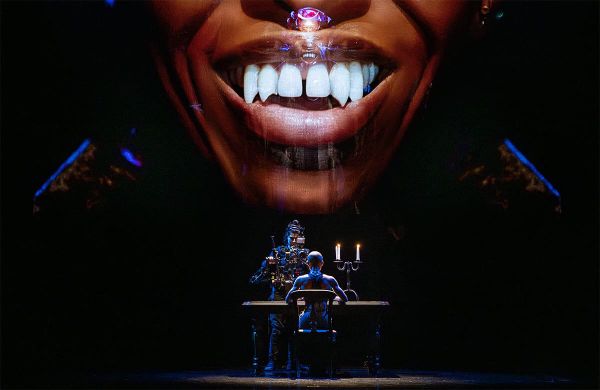
We’ll start by saying this is a huge endurance test for Erivo – the play clocks in at two hours without an interval; she is on-stage the whole time, playing every character, speaking every line. That she can get through this is a commendable feat. We’re aware that what she is doing is incredibly tough, but unfortunately, that sometimes comes across – occasionally it feels like hard work. Erivo doesn’t always seem secure in the material; there are a handful of false starts, which does disrupt the flow from time to time. At one point we do get to hear her sing – it’s brilliant, but short lived. We’d have liked a little more of this.
It’s difficult not to compare this production to director Kip Williams’ The Picture of Dorian Gray, as this is effectively exactly the same format, by the same creative team. If you didn’t catch that production, then Dracula is a new, novel, exciting way to stage a story, one which cleverly blurs the line between theatre and film. If you did see that show, however, then Dracula is exactly the same thing, and it’s far less exciting second time around.
We were also a bit disappointed by how much the screen was used to convey other characters: in The Picture of Dorian Gray this element was used sparingly, usually for more minor characters, with the focus always on the on-stage Sarah Snook as the star of the show. In Dracula the technology is used far more regularly; often there will be multiple important characters portrayed on screen, with the on-stage Erivo relegated to a bit-part, the focus being on the pre-recorded characters. It creates a sense of distance between the audience and the action, which isn’t ideal for the horror genre.
To be honest that’s probably the key shortcoming here: the show really is lacking in suspense. There’s not really any sense of dread throughout, or a feeling that we’re building up to some sort of horrific climax; there’s a disconnect between the audience and the action, because too much of the action isn’t happening live on stage.
We still had a reasonably enjoyable evening with Dracula – while we’ve seen this format before, it still makes for an entertaining evening of theatre. The role would be trying for any actor, and for the most part Cynthia Erivo copes admirably, although we’re only very occasionally afforded flashes of her true brilliance. It’s also disappointing that the show lacks suspense, and that its star is frequently sidelined in favour of technological trickery. While it still makes for an entertaining night out, Dracula falls short of expectations.
GAY TIMES gives Dracula – 3/5
More information can be found here.