“Absolutely fierce”: Are grassroots sports clubs the answer to our community crisis?
If you can’t find community, how can you build confidence? Ballroom culture, drag bars, handkerchief code, green carnations – queer people have always found ways to be together.
In Partnership with Voltarol Words by Emily Cameron
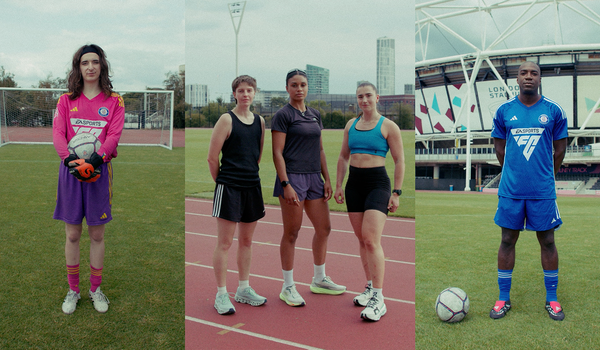
Today, grassroots sports clubs provide fresh pastures for building community. In London, Les Run brings queers together to run with a strong social aspect post-run. Stonewall FC – founded in 1991 and the UK’s longest standing LGBTQ+ football team – goes beyond sport, building confidence in its players' everyday lives. In an inspiring challenge, actor and dancer Joshua Hubbard has attempted to relate these lessons in community back to his home town of Oldham by staging a performance of locals, many of whom have never danced before. Finding community can be difficult, but increasingly queer people are turning to grassroots sports clubs.
Growing up queer in a small town is a familiar experience for all too many of us. Even for those of us that grew up in cities, rural queerphobia is the subject of so much culture that we are implicitly aware. The result is widespread queer displacement from towns to cities.
Voltarol partnered with Channel 4 to explore Joshua’s experience as a young queer person in Oldham, and his return to the town. From a young age, Joshua felt a divide between himself and his other classmates. “You get othered and pushed to the side a little bit from the other boys,” he said. More recently, a 2024 study by GALOP titled Hate Happens: Technology’s Role in Addressing anti-LGBTQ+ Hate Encounters in the UK with 688 respondents, found that 3 in 5 anti-LGBTQ+ hate incidents reported to their app Zoteria occurred outside of major cities.
It’s little wonder that a 2024 Pride In Leadership report Barriers to LGBTQ+ Career Progression in the UK survey found that 80% of the 1017 LGBTQIA+ professionals who responded said that their identity influenced where they chose to live. For Joshua this urge was strong from a young age: “At my sixth form college I had Sharon, who was a dance teacher. She was like ‘Why do you want to dance?’ And the first thing I said to her was, ‘I want to get out of this town.’”
The mass migration of queer people towards metropolises creates a yearning for community. Together, Gay Times and Voltarol have been exploring the role that queer sport clubs play in the formation of community for those who are experiencing some level of queer-displacement. For comedian Ciara the change was stark – “when I moved to London I didn’t know anyone at all.” So many of us have been there, inspired to move to the big city and find community and then confronted with the mortifying ordeal of actually looking for friends. Joining Les Run was “mostly just to find friends”, but the results were far more far reaching.
”It opened up a whole new world that I just wasn’t exposed to before,” says Les Run co-founder Robyn J Tallis, “and I think it's done that for other people as well.” With regular meetings, mutual encouragement and shared interests, “the connections that’ve come out of Les Run are much deeper than ones elsewhere.”
Through his dance troupe in Oldham, Joshua was able to manifest many of the same feelings of community. From an initial inkling that the project would be difficult, those that took part quickly saw the community benefits. “Making connections,” “meeting new people” and “really cool new friends” were just some of the encouraging comments fed back to Joshua during the process.
For Joshua this was very much the point – to build community and instil some of the confidence he felt when he first started dancing. “I remember feeling absolutely fierce,” he recalls of his first time on stage. Fierce, however, was not how the people of Oldham stuck him on arrival: “People really struggle to step out of their comfort zones [...] I just think there’s a lack of confidence in the community in general.” By the end of the project, he saw a completely different side of the dancers, and was rightfully proud of some genuinely inspiring work. “Seeing them really comfortable in themselves… it’s nice to have been able to enable that.” As for the participants, they were resolved to chase that feeling going forward – “my goal is to keep putting myself out there and doing stuff that’s going to push me outside my comfort zone.”
On the city side of the question, sports clubs have a similar effect on confidence – most tangibly for AJ, goalkeeper for Stonewall FC’s Women and Non-binary team, who joined the team at a particularly difficult moment for her personally and for trans people in the UK. Where public life often makes her feel she wants to hide, Stonewall FC is “one of those places where [she] can just feel comfortable and relaxed.” “When I’m on a Stonewall FC football pitch,” she continues, “I feel completely like I can be myself.” In an enormous personal step, the confidence this community gave her allowed her to fully step into her name and identity for the first time at Stonewall FC. Changing names is hard, but community will always make it easier.
These movement-based community groups are undeniably life changing. It comes up time and time again in interviews. For Stonewall FC First XI captain Jay, “coming out changed my life – but also football’s changed my life.” For AJ the above is obviously life changing. For Robyn and Les Run co-founder Phoebe Webster they agreed that Les Run was life changing both for them as founders and for those that attend. For Joshua’s dancers in Oldham, they resolved to push themselves into new things more. Collective movement is always positive, for the person and the group – it strengthens community and emboldens our confidence, we’re better when we move together.
Gay Times is working in partnership with Voltarol to better understand the joy of movement. Find out more about Voltarol here.
From hot-takes to hard-hitting journalism, our long-reads put you at the centre of queer life and culture. The best LGBTQ writing, insight and opinion, curated for you.
Support our work by subscribing today and enjoy must-read stories by the voices you love.